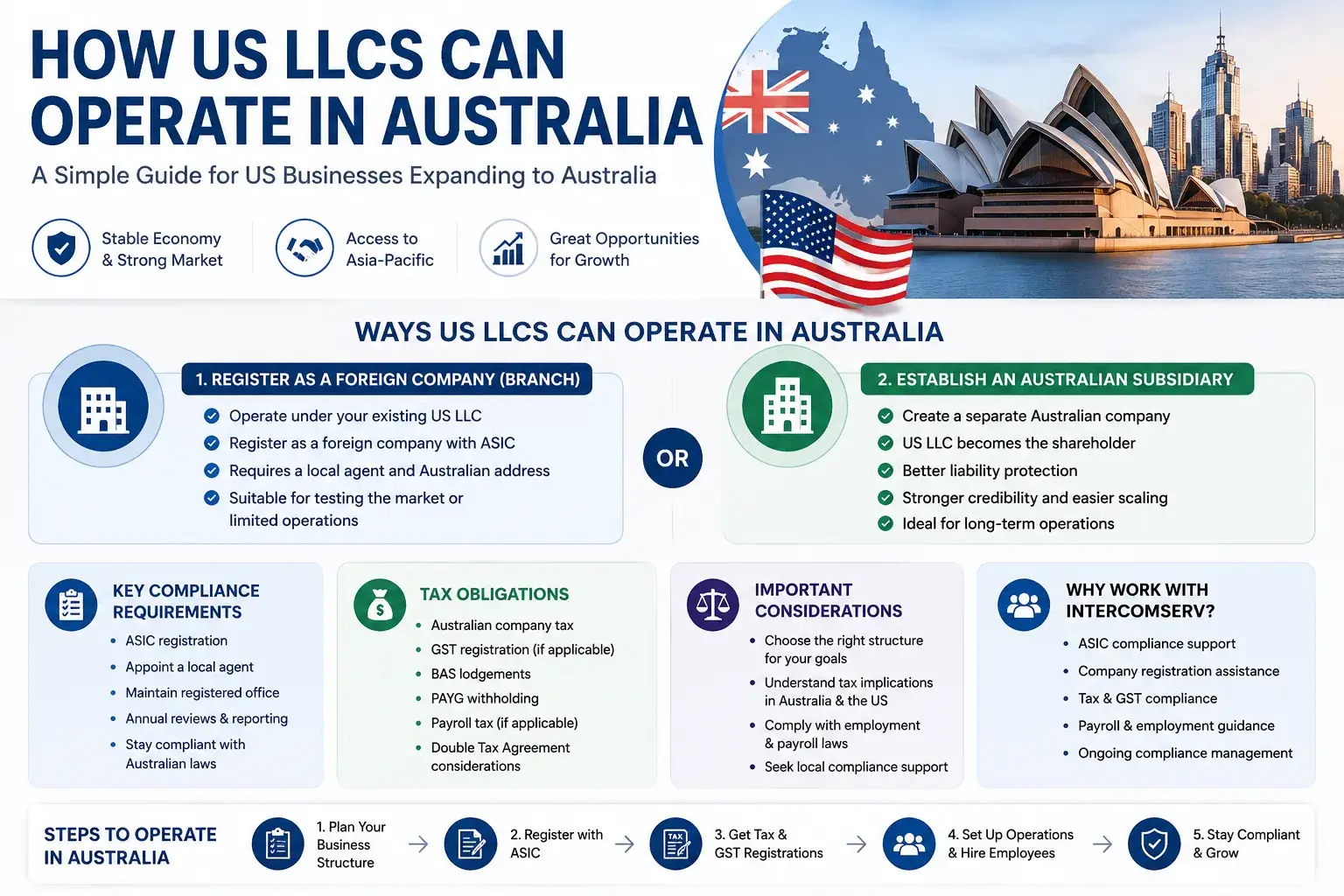
Australia has become an attractive expansion market for US businesses seeking international growth, access to Asia-Pacific markets, and a stable business environment. However, before operating in Australia, US LLCs must understand the local regulatory, taxation, and compliance framework.
Many US business owners assume they can directly operate in Australia using their existing US LLC structure. While this is possible in some cases, Australian regulations often require additional registrations, local compliance obligations, and business structuring decisions.
This guide explains how US LLCs can operate in Australia, the available business structures, compliance requirements, taxation considerations, and the key steps involved in entering the Australian market.
Can a US LLC Operate in Australia?
Yes, a US LLC can operate in Australia. However, the structure and scope of operations determine the legal and compliance requirements involved.
US businesses entering Australia typically operate through one of the following models:
- Registering a foreign company branch
- Establishing an Australian subsidiary company
- Partnering with an Australian entity
- Operating limited activities remotely
The right approach depends on factors such as operational goals, taxation strategy, staffing plans, and long-term expansion objectives.
Common Ways US LLCs Operate in Australia
1. Registering as a Foreign Company
A US LLC can register with the Australian Securities and Investments Commission (ASIC) as a foreign company.
This allows the LLC to legally conduct business activities in Australia while remaining connected to the US parent entity.
Suitable For
- Businesses testing the Australian market
- Companies with limited local operations
- International firms operating under a central global structure
Key Requirements
- ASIC foreign company registration
- Appointment of a local agent
- Australian registered office address
- Ongoing reporting obligations
Important Consideration
The US LLC remains legally responsible for Australian operations because the branch is not considered a separate legal entity.
2. Establishing an Australian Subsidiary
Many US businesses choose to incorporate a separate Australian company instead of operating directly through the LLC.
Under this model:
- A new Australian company is created
- The US LLC becomes the shareholder
- The Australian entity operates independently
Advantages
- Better liability protection
- Easier local banking and contracts
- Stronger credibility with Australian clients
- Simplified long-term scaling
- Clearer tax separation
For many growing US businesses, this is often the preferred structure for long-term Australian expansion.
Does a US LLC Need ASIC Registration?
If a US LLC is carrying on business activities in Australia, ASIC registration is generally required.
Examples of activities that may trigger registration obligations include:
- Hiring employees in Australia
- Operating a physical office
- Signing local contracts
- Generating ongoing Australian revenue
- Conducting regular business operations locally
Failure to comply with ASIC requirements may result in penalties and regulatory complications.
Australian Tax Obligations for US LLCs
Tax obligations depend on the structure used and the nature of Australian business activities.
US LLCs operating in Australia may need to manage:
- Australian company tax
- Goods and Services Tax (GST)
- Business Activity Statement (BAS) lodgements
- Payroll tax obligations
- PAYG withholding requirements
Tax residency and permanent establishment rules can also affect how income is taxed between Australia and the United States.
Because international tax structures can become complex, businesses should assess both Australian and US tax implications before expansion.
GST Registration Requirements
US LLCs may need GST registration if their Australian turnover exceeds the GST threshold or if they provide taxable services within Australia.
GST obligations can include:
- Charging GST on eligible sales
- Filing BAS reports
- Maintaining financial records
- Reporting taxable transactions
Understanding GST obligations early helps avoid future compliance risks.
Can a US Citizen Be a Director of an Australian Company?
Yes, a US citizen can become a director of an Australian company.
However, Australian companies often require at least one Australian resident director depending on the structure used.
This is one of the most important compliance considerations for foreign businesses entering Australia.
Hiring Employees in Australia
US LLCs hiring Australian employees must comply with Australian employment and payroll laws.
This may include:
- PAYG withholding
- Superannuation contributions
- Employment agreements
- Fair Work compliance
- Payroll reporting obligations
Australian employment regulations differ significantly from US systems, making local compliance support important for expanding businesses.
Subsidiary vs Branch for US LLCs
Australian Subsidiary
Benefits
- Separate legal entity
- Reduced liability exposure
- Stronger local market presence
- Easier long-term scaling
Considerations
- ASIC compliance obligations
- Local reporting requirements
- Corporate administration responsibilities
Foreign Branch
Benefits
- Centralised global structure
- Faster market entry in some cases
- Simplified ownership structure
Considerations
- Parent company liability exposure
- Additional international reporting complexity
- Less operational flexibility
The ideal structure depends on the company’s expansion goals, tax planning, and operational strategy.
Compliance Obligations US LLCs Should Understand
US businesses operating in Australia may need ongoing support with:
- ASIC annual reviews
- Company record maintenance
- ATO reporting obligations
- Tax registrations
- Payroll compliance
- Financial reporting
- Director compliance requirements
Managing these obligations proactively helps reduce risks and operational disruption.
Common Mistakes US Businesses Make When Expanding to Australia
Assuming US Compliance Rules Apply
Australian corporate and taxation frameworks operate differently from US regulations.
Ignoring ASIC Obligations
Many foreign businesses underestimate the importance of ASIC compliance requirements and annual obligations.
Choosing the Wrong Structure
Selecting an unsuitable structure can create taxation inefficiencies and compliance issues later.
Delaying GST and Tax Registrations
Late registrations can create financial penalties and operational complications.
How IntercomServ Supports US Businesses Expanding into Australia
IntercomServ helps US companies understand and manage Australian compliance obligations with structured support tailored to international businesses.
We assist with:
- ASIC compliance guidance
- Foreign company registration support
- Australian subsidiary setup assistance
- Ongoing compliance management
- Regulatory and reporting guidance
Our goal is to help US businesses enter the Australian market with greater operational clarity and compliance confidence.
Conclusion
US LLCs can successfully operate in Australia, but entering the market requires careful planning around business structure, ASIC obligations, taxation, and ongoing compliance responsibilities.
For many businesses, establishing an Australian subsidiary provides stronger long-term scalability and operational flexibility. Others may initially operate through a foreign branch structure depending on their business model.
Understanding Australian compliance requirements early helps reduce regulatory risks and supports smoother market expansion.