How the UK–Australia Double Tax Agreement Works
Expanding a UK business into Australia is a high-growth opportunity—but without the right tax structure, it can quickly become expensive and complex.
From double taxation risks to unclear Permanent Establishment (PE) exposure, many UK companies lose significant profits due to poor planning and misunderstanding of Australian tax obligations.
The UK–Australia Double Tax Agreement (DTA) is designed to eliminate these risks. When applied correctly, it allows businesses to reduce tax liabilities, avoid double taxation, and operate with predictable financial outcomes across both jurisdictions.
In this 2026 guide, you’ll learn how the UK–Australia tax treaty works, what benefits apply to your business, and how to structure your Australian expansion in the most tax-efficient way.
What Is the UK–Australia Double Tax Agreement (DTA)?
The UK–Australia Double Tax Agreement (DTA) is a bilateral tax treaty between the UK and Australia that determines:
- Which country has the right to tax specific income
- How to avoid double taxation
- How cross-border profits are treated
For detailed legal provisions and the full treaty text, refer to the official UK government guidance on Australia tax treaties.
Core Purpose
Prevent tax avoidance and profit shifting
Eliminate double taxation
Reduce withholding taxes
Provide legal clarity for cross-border operations
Do UK Companies Pay Tax in Australia?
Yes—but only under specific conditions.
A UK company is taxed in Australia if:
- It has a Permanent Establishment (PE)
- It earns Australian-sourced income
Otherwise, profits are generally taxed only in the UK.
Key Tax Treaty Benefits for UK Companies (2026)
1. Elimination of Double Taxation
Without the treaty, businesses could be taxed in both the UK and Australia.
With the treaty:
- Companies can claim Foreign Tax Credit Relief (FTCR) in the UK
- Australian taxes paid are offset against UK liabilities
Result: Income is not taxed twice.
2. Reduced Withholding Tax Rates
| Income Type | Standard Rate | Treaty Rate |
|---|---|---|
| Dividends | Up to 30% | 0%–15% |
| Interest | 30% | Max 10% |
| Royalties | 30% | Max 5% |
These reduced rates improve profit repatriation and overall tax efficiency.
3. Permanent Establishment (PE) Protection
The treaty ensures that UK companies are only taxed in Australia if a Permanent Establishment exists.
Common PE triggers:
- Physical office or branch
- Employees operating locally
- Dependent agents closing deals
Typically not considered PE:
- Remote service delivery
- Short-term visits
- Preparatory or auxiliary activities
4. Capital Gains Tax (CGT) Advantages
UK companies can often avoid Australian Capital Gains Tax when selling shares or exiting investments, provided the assets are not primarily linked to Australian real estate.
5. Employment & Expatriate Tax Relief
UK employees working temporarily in Australia may avoid local tax if:
- They stay under 183 days
- Salary is not paid by an Australian entity
- No PE is triggered
Best Business Structures for UK Expansion into Australia
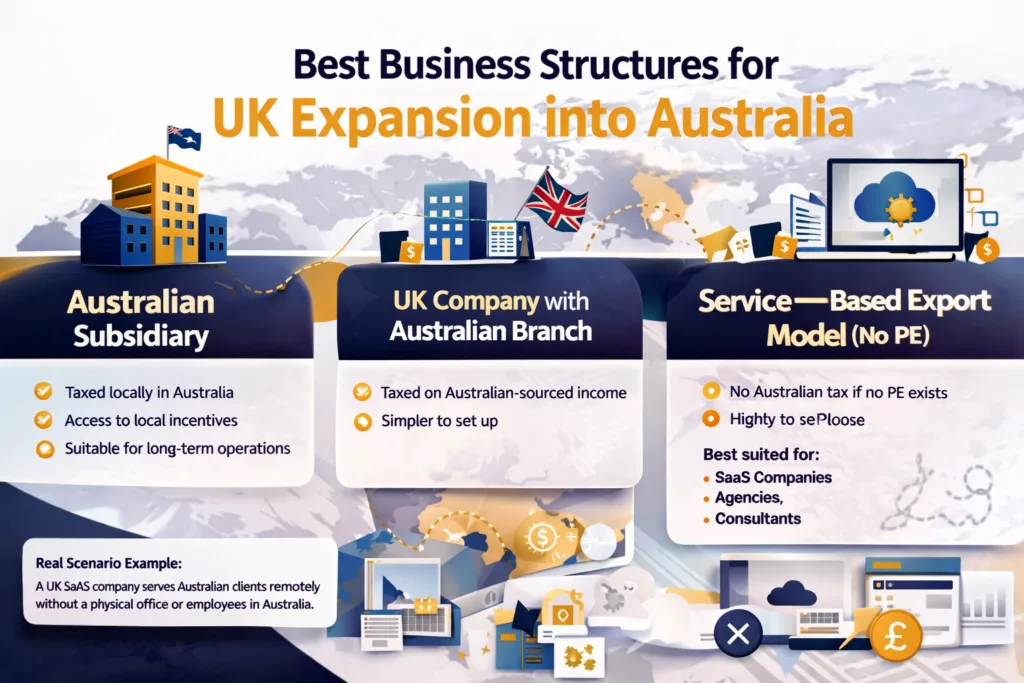
1. Australian Subsidiary
- Taxed locally in Australia
- Access to local incentives
- Suitable for long-term operations
2. UK Company with Australian Branch
- Taxed on Australian-sourced income
- Simpler to set up
3. Service-Based Export Model (No PE)
- No Australian tax if no PE exists
- Highly tax-efficient
Best suited for:
- SaaS companies
- Agencies
- Consultants
Real Scenario Example
A UK-based SaaS company serves Australian clients remotely without a physical office or employees in Australia.
Outcome:
- No Permanent Establishment
- No Australian corporate tax
- Profits taxed only in the UK
This is one of the most tax-efficient expansion models.
Strategic Tax Planning Considerations
Transfer Pricing Compliance
- Intercompany transactions must reflect market value
- Proper documentation is required
Use of Tax Credits & Incentives
- Claim foreign tax credits in the UK
- Explore Australian R&D incentives
Documentation Requirements
- Tax residency certificates
- Clear contracts
- Accurate income classification
2026 Updates and Implications
Recent developments in UK–Australia trade relations have led to:
- Updated rules for digital economy taxation
- Improved clarity around tax residency
- Streamlined dispute resolution processes
- Stronger anti-avoidance measures
These changes increase both opportunity and compliance expectations.
Common Mistakes to Avoid
- Misinterpreting Permanent Establishment rules
- Misclassifying income (royalties vs services)
- Failing to provide residency documentation
- Ignoring transfer pricing regulations
- Overpaying withholding taxes
Next Steps: Structuring Your Expansion the Right Way
Choosing the right structure for your Australian expansion isn’t just a compliance step—it directly impacts how much tax you pay, your exposure to Permanent Establishment risk, and your long-term profitability. Many UK companies overpay taxes or face unexpected liabilities simply because they set up incorrectly from the start. Whether you’re entering the market remotely, setting up a branch, or establishing a subsidiary, getting expert guidance early can prevent costly mistakes and unlock the full benefits of the tax treaty. If you’re planning your expansion, explore our advisory services in Australia to ensure your structure is fully optimized and compliant from day one.
Conclusion
Expanding into Australia offers significant growth opportunities for UK companies—but tax efficiency depends on proper structuring.
The UK–Australia Double Tax Agreement allows businesses to:
- Avoid double taxation
- Reduce withholding tax rates
- Gain clarity on tax obligations
In 2026, businesses that understand and apply these treaty benefits effectively will have a strong competitive advantage in international expansion.
FAQ
Do UK companies need to register for tax in Australia?
Only if they have a Permanent Establishment or taxable presence.
What is the withholding tax rate between the UK and Australia?
Dividends: 0–15%, Interest: 10%, Royalties: 5%.
Can a UK company avoid Australian tax completely?
Yes, if it has no Permanent Establishment and operates remotely.
How do you claim tax treaty benefits?
By providing proof of tax residency and complying with reporting requirements in both countries.
What triggers a Permanent Establishment in Australia?
A fixed place of business, employees, or dependent agents operating locally.