Payroll is one of those business functions that looks simple on the surface but becomes surprisingly complex once compliance, tax rules, awards, and reporting obligations are added. Even small errors can lead to employee dissatisfaction, ATO penalties, and long-term compliance risks. Understanding the payroll mistakes Australia businesses frequently make is the first step toward building a more reliable and compliant payroll system.
This guide breaks down the most common issues, why they happen, and how to avoid them in line with Australian payroll regulations and current compliance expectations.
Why do payroll errors occur more often than expected
Many businesses assume payroll is just calculating hours and paying wages. In reality, it involves superannuation, PAYG withholding, award interpretation, leave entitlements, and record-keeping. Without strong payroll management Australia practices, even experienced teams can slip into avoidable errors.
A major issue is that payroll rules change frequently, and businesses often fail to update systems or processes accordingly. This is where the most common payroll errors begin.
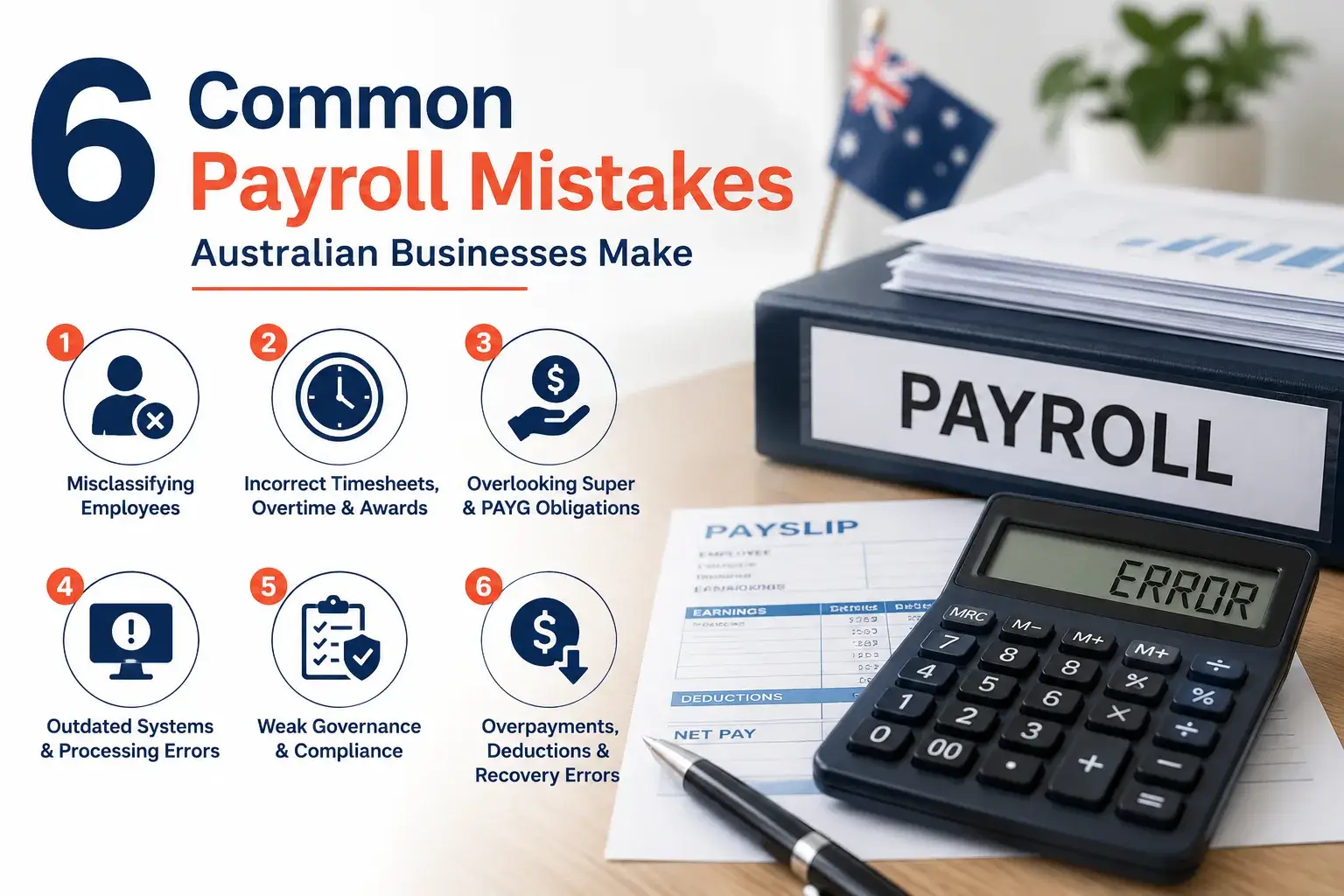
6 payroll mistakes Australian businesses make
Mistake #1: Misclassifying employees and incorrect employment status
One of the most serious issues behind payroll mistakes in Australia is the incorrect classification of workers. Employees, contractors, casuals, and part-time staff all have different entitlements and tax obligations.
Misclassification can result in underpayment of superannuation, incorrect tax withholding, and breaches of payroll compliance requirements under Fair Work and the ATO.
For example, treating a contractor like an employee (or vice versa) can lead to back payments and penalties. Businesses must regularly review contracts and ensure roles align with legal definitions under the payroll compliance Australia standards.
Mistake #2: Incorrect timesheets, overtime, and award interpretation
A significant number of payroll processing errors come from inaccurate timesheets or a misunderstanding of modern awards.
Awards in Australia can include penalty rates, overtime conditions, allowances, and shift loadings.
A simple data entry mistake, such as missing overtime hours, can quickly lead to underpayment claims. This is one of the most frequent payroll compliance mistakes seen across industries.
Employers should ensure timesheet systems are automated where possible and aligned with award interpretations. Regular audits also help reduce errors in payroll obligations in Australia, especially for businesses with shift workers or casual staff.
Mistake #3: Overlooking superannuation and PAYG obligations
Superannuation and PAYG withholding are core responsibilities for every employer. Yet, they are also among the most commonly mishandled areas of payroll.
Failing to pay super on time or calculating PAYG incorrectly can trigger ATO scrutiny. According to the ATO’s guidance on payroll governance, strong internal controls and reconciliation processes are essential for reducing compliance risks.
Many businesses underestimate how strict payroll compliance expectations are in this area. Even small delays or miscalculations can snowball into larger financial and legal issues.
Mistake #4: Payroll processing errors caused by outdated systems
Another major contributor to payroll mistakes Australia is outdated or poorly integrated payroll software. Manual spreadsheets, disconnected HR systems, and inconsistent data entry all increase the risk of error.
These payroll processing errors often result in incorrect payslips, duplicate payments, or missed deductions. Over time, they can significantly affect employee trust and business credibility.
Modern payroll management systems help automate calculations, reduce human error, and ensure real-time compliance updates. However, technology alone is not enough; systems must still be properly configured and monitored.
Mistake #5: Weak payroll governance and compliance oversight
Strong governance is essential for maintaining compliance with tax and employment laws. The ATO highlights that businesses need structured oversight, regular audits, and documented payroll processes to meet obligations effectively.
Without governance, businesses risk inconsistent reporting and repeated payroll compliance mistakes. This is especially common in growing organisations where payroll becomes more complex, but processes remain informal.
A lack of internal checks is one of the hidden causes behind ongoing payroll mistakes Australia businesses face.
Mistake #6: Overpayments, deductions, and recovery errors
Overpayments are more common than many businesses realise. They often happen due to incorrect hours, duplicate entries, or system glitches. However, recovering overpaid wages must be handled carefully under Fair Work guidelines.
Employers cannot simply deduct money without a proper agreement or legal basis. Fair Work outlines strict rules around overpayments and deductions to ensure fairness and compliance.
Poor handling of this area often leads to disputes and reputational damage. It is a key area where payroll compliance requirements must be followed closely to avoid legal complications.
What happens if payroll is incorrect in Australia?
Payroll errors can lead to serious consequences depending on the severity and frequency. These may include:
- ATO penalties for incorrect tax reporting
- Back payments for underpaid wages
- Interest charges on unpaid superannuation
- Employee disputes and legal claims
- Damage to business reputation
Even minor inconsistencies can trigger audits, especially if they indicate ongoing payroll processing errors or weak internal controls.
How can businesses avoid payroll compliance mistakes?
Preventing errors requires a combination of systems, training, and regular review. Many payroll compliance mistakes occur due to a lack of awareness rather than intent.
A few habits separate the businesses that stay out of trouble:
- Keep employee records current: names, TFNs, super details, and employment status, reviewed regularly, not just at onboarding.
- Match software to current legislation: award rates, super percentages, and tax tables change, and your system should reflect that automatically.
- Document who’s responsible for what: clear accountability makes errors easier to catch early.
- Reconcile monthly, not just at tax time: a quick check against STP and super contributions catches issues before they grow.
- Get a second set of eyes on terminations and overpayments: these are handled less often, which is exactly where costly mistakes hide.
Strong payroll management Australia practices help reduce risk and ensure consistent compliance across all employee categories.
Getting it right doesn’t have to fall entirely on you
Payroll isn’t impossible, but it is detailed, constantly shifting, and unforgiving of small oversights. The pattern is almost always the same: not enough time, not enough specialist knowledge, and no backup when something changes.
At Intercom Serv (ICS), we work with Australian businesses every day to take that pressure off internal teams. Our outsourced payroll services are built around accuracy, current legislation, and process discipline that catches errors before they become liabilities.
If payroll has become more of a worry than it should be, get in touch with our team for a chat about how we can help you stay compliant, accurate, and ahead of the next deadline.