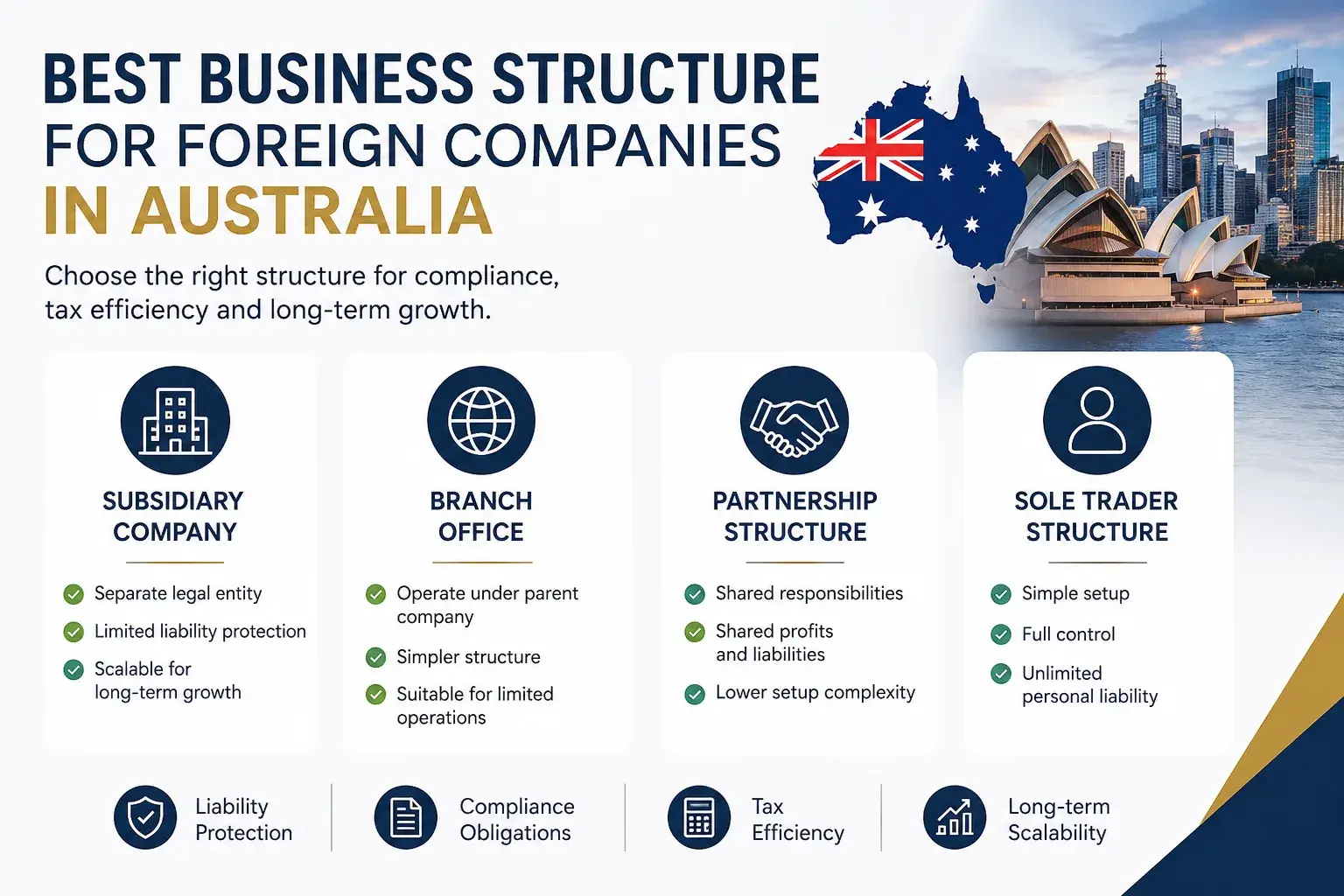
Expanding into Australia can create significant growth opportunities for international businesses. However, before operating in the Australian market, foreign companies must choose the right business structure to ensure compliance, tax efficiency, operational flexibility, and long-term scalability.
The business structure you select affects everything from ASIC obligations and tax liabilities to liability protection and expansion potential. For foreign businesses entering Australia, choosing the wrong structure can create unnecessary compliance risks, higher taxation exposure, and operational limitations.
This guide explains the best business structures for foreign companies in Australia, how each structure works, and which option may suit your business objectives.
Why Business Structure Matters for Foreign Companies
Australia has a regulated corporate and taxation environment. Foreign businesses operating locally must comply with obligations set by the Australian Securities and Investments Commission (ASIC) and the Australian Taxation Office (ATO).
Your chosen structure impacts:
- Legal liability
- Tax obligations
- Reporting requirements
- Ability to hire employees
- Banking and operational setup
- Investor and partnership opportunities
- Long-term expansion strategy
Selecting the correct structure from the beginning helps reduce future restructuring costs and compliance complications.
Common Business Structures for Foreign Companies in Australia
1. Australian Subsidiary Company
An Australian subsidiary is one of the most common structures used by foreign companies entering Australia.
Under this model, a separate Australian company is incorporated and registered with ASIC. The foreign parent company owns shares in the Australian entity.
Key Features
- Separate legal entity from the parent company
- Registered with ASIC
- Receives its own Australian Company Number (ACN)
- Can operate independently in Australia
- Subject to Australian corporate tax obligations
Advantages
- Limited liability protection
- Stronger credibility with Australian clients and banks
- Easier compliance management
- Better scalability for long-term operations
- Simplifies local hiring and contracts
Considerations
- Requires ongoing ASIC compliance
- Annual reporting obligations apply
- Director requirements must be met
- Australian tax filings are mandatory
For many international businesses, especially US and UK companies, a subsidiary is often considered the most stable and scalable structure for operating in Australia.
2. Foreign Company Branch Office
A branch office allows a foreign company to directly operate in Australia without creating a separate Australian legal entity.
The overseas company registers as a foreign company with ASIC and conducts business under the parent entity.
Key Features
- No separate Australian company created
- Parent company remains legally responsible
- Registered as a foreign company with ASIC
- Australian operations remain linked to the overseas entity
Advantages
- Simpler structure in some cases
- Centralised control from the parent company
- Suitable for limited Australian operations
Considerations
- Parent company may carry legal liability
- More complex international taxation considerations
- Additional foreign reporting obligations
- Less flexibility for local investment or scaling
Branch structures are sometimes suitable for companies testing the Australian market before establishing a permanent subsidiary.
3. Partnership Structure
Foreign businesses occasionally enter Australia through partnerships with local businesses or individuals.
Key Features
- Shared operational responsibilities
- Shared profits and liabilities
- Governed by partnership agreements
Advantages
- Lower setup complexity
- Shared local expertise
- Reduced initial operational burden
Considerations
- Liability risks can be higher
- Potential disputes between partners
- Limited scalability
- May not suit larger international operations
Partnerships are generally less common for structured international expansion compared to subsidiaries.
4. Sole Trader Structure
A sole trader structure is generally not recommended for foreign companies entering Australia at scale.
Key Features
- Operated by an individual
- No separate legal entity
- Simplified setup process
Limitations for Foreign Businesses
- Unlimited personal liability
- Limited credibility for international operations
- Poor scalability
- Restricted investment potential
This structure is more suitable for freelancers or independent consultants rather than foreign corporate entities.
Which Business Structure Is Best for Foreign Companies?
For most foreign businesses expanding into Australia, the best structure is typically either:
- An Australian subsidiary company
- A registered foreign branch office
The ideal choice depends on:
- Business goals
- Tax strategy
- Risk tolerance
- Expansion plans
- Staffing requirements
- Investor expectations
- Operational complexity
Companies planning long-term operations, hiring employees, and building an Australian presence often benefit from establishing a subsidiary structure.
Important Compliance Requirements
Regardless of structure, foreign companies operating in Australia may need to manage:
- ASIC registration
- Annual company reviews
- ATO tax registrations
- GST registration
- BAS lodgements
- PAYG obligations
- Director compliance requirements
- Financial reporting obligations
Understanding these responsibilities early helps reduce regulatory risks and penalties.
You can also read our guide on ASIC compliance requirements for international businesses and learn how Australian corporate obligations differ from taxation responsibilities.
Factors to Consider Before Choosing a Structure
1. Tax Implications
Different structures create different tax obligations in Australia and internationally. Double taxation agreements may also affect your decision.
2. Liability Protection
Subsidiary structures generally offer stronger legal separation between the parent company and Australian operations.
3. Long-Term Growth
If expansion and local hiring are planned, a scalable structure is essential.
4. Compliance Management
Some structures involve more ongoing reporting and regulatory obligations than others.
5. Market Entry Strategy
Businesses testing the market may initially choose a branch office before transitioning into a subsidiary.
How IntercomServ Supports Foreign Businesses
Navigating Australian business structures and compliance requirements can be complex for overseas companies. IntercomServ helps foreign businesses understand their obligations and establish the right operational framework for entering the Australian market.
Our team supports international businesses with:
- ASIC registration guidance
- Foreign company compliance support
- Australian subsidiary setup assistance
- Ongoing compliance management
- Regulatory and reporting guidance
Conclusion
Choosing the best business structure for foreign companies in Australia is one of the most important decisions during market entry. The right structure supports compliance, reduces operational risk, and creates a stronger foundation for long-term growth.
For many international businesses, an Australian subsidiary offers the best combination of scalability, credibility, and liability protection. However, the ideal structure depends on your operational goals, tax considerations, and expansion plans.
Understanding your obligations early can help your business enter the Australian market with greater confidence and fewer compliance challenges.
FAQs
What is the best business structure for foreign companies in Australia?
For many foreign businesses, an Australian subsidiary company is often the preferred structure because it provides liability protection, operational flexibility, and long-term scalability.
Can a foreign company operate directly in Australia?
Yes. Foreign companies can operate in Australia by registering a branch office with ASIC or by establishing an Australian subsidiary company.
Does a foreign company need ASIC registration?
Yes. Foreign businesses operating in Australia generally need ASIC registration, either as a foreign company or through an Australian incorporated entity.